Data Overview
The CNeuroMod databank comprises 23 datasets acquired across
6 deeply-sampled participants (sub-01–sub-06), spanning
naturalistic movie and audiobook listening, videogame play, controlled cognitive
localizers and continuous-recognition paradigms.
Summary Statistics
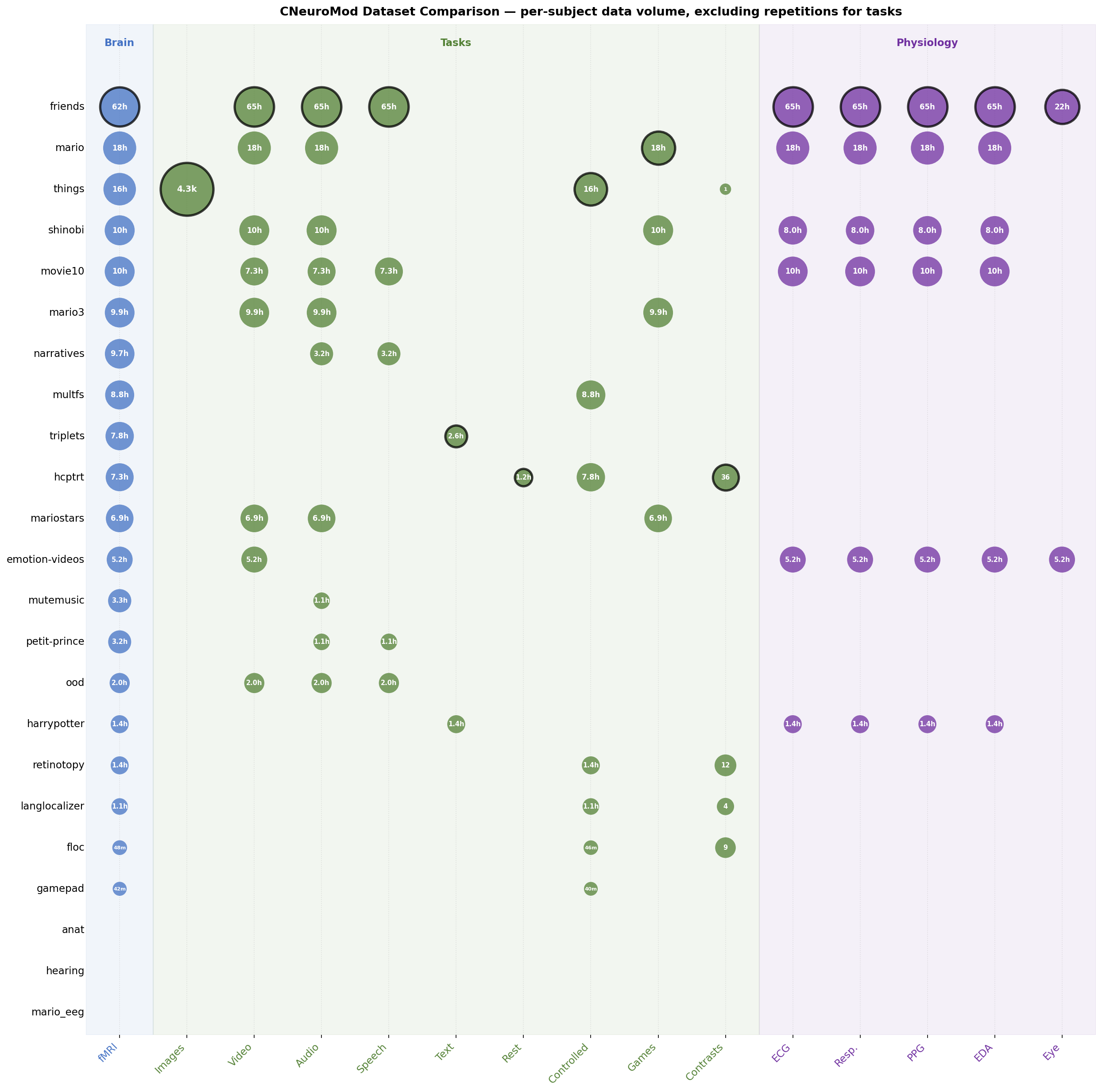
Figure 1:Per-subject data volume across CNeuroMod datasets. Rows are individual datasets, columns group recording modalities (fMRI, naturalistic stimuli, controlled-task regressors, physiology, eye tracking), and bubble area is proportional to the hours of unique per-subject content, excluding stimulus repetitions.
The databank totals 953 hours of fMRI across all participants and datasets, or 183 hours per subject on average. Physiological recordings accompany most fMRI sessions: 584 hours of ECG, 584 hours of respiration, 584 hours of plethysmography and 584 hours of electrodermal activity, alongside 136 hours of eye tracking wherever the in-scanner eye tracker was available.
Coverage is not uniform across the six participants. sub-04 has the most limited
footprint, missing or partial in 18 of the
23 datasets, followed by sub-05
(6 datasets) and sub-06
(5 datasets); sub-01 and sub-03 each have a
single gap. Beyond per-subject availability, one dataset withholds content by design:
friends releases the stimuli for season 7 but keeps the corresponding fMRI responses
held out as an in-distribution test set for encoding-model benchmarks, including the
Algonauts Project 2025 Challenge.
Dataset Coverage
anat
The anat dataset comprises longitudinal anatomical and upper-spinal-cord MRI collected
at roughly four sessions per year to monitor structural stability over the course of the
study. Cortical flat maps and quantitative measures such as gray-matter morphometry,
tractography and myelination can be derived from the FreeSurfer derivatives it provides.
emotion-videos
(No overview text is yet available for this dataset — its cneuromod.all entry has not
been documented with a README.)
floc
Four participants (sub-01, sub-02, sub-03, sub-05) completed six sessions of a
functional localizer task designed to identify brain regions that respond preferentially
to specific stimulus categories, adapting the Stanford VPN lab’s fLoc task
St-Laurent et al., 2026.
friends
This dataset contains fMRI data acquired while six CNeuroMod participants watched episodes of the American sitcom Friends (seasons 1–7) in English, with brain responses synchronized to visual frames, audio samples and time-stamped transcripts. It has served as a benchmark corpus for multimodal movie-encoding challenges. [MISSING REF: Gifford et al. (2025), “The Algonauts Project 2025 Challenge: How the Human Brain Makes Sense of Multimodal Movies” — full bibliographic details (venue/DOI) needed]
gamepad
This dataset validates the CNeuroMod videogame controller, an open-source, fiber-optic, MRI-compatible game controller designed by the project’s engineering team [MISSING REF: Harel, Y., Cyr, A., Boyle, J., Pinsard, B., Bernard, J., et al. (2023). “Open design of a reproducible videogame controller for MRI and MEG.” PLOS ONE, 18. doi: 10.1371/journal.pone.0290158], comparing it against a commercial SNES-like controller across alternating mock-scanner and MRI sessions.
harrypotter
Five participants read Chapter 9 of Harry Potter and the Sorcerer’s Stone, presented word by word at 2 Hz across seven runs in a single session, using the same stimuli as the separate fMRI dataset reported by Wehbe et al. (2014).
hcptrt
Participants repeated the functional localizers developed by the Human Connectome Project 15 times each, accumulating approximately 10 hours of functional data per subject across seven tasks adapted from the HCP task-fMRI protocol Rastegarnia et al., 2023. Sessions typically combined either two repetitions of the HCP localizers, or one resting-state run and one HCP localizer run.
hearing
(No overview text is yet available for this dataset — its cneuromod.all entry has not
been documented with a README.)
langlocalizer
(No overview text is yet available for this dataset — its cneuromod.all entry has not
been documented with a README.)
mario
Five CNeuroMod participants played Super Mario Bros. (Nintendo, 1985) in-scanner across 22 of the game’s original levels, in a structured discovery phase followed by a longer practice phase of randomly selected levels Paugam et al., 2025. Prior gameplay experience varied across participants, from no videogame experience to regular players who had already completed the game.
mario3
(No overview text is yet available for this dataset — its cneuromod.all entry has not
been documented with a README.)
mario_eeg
(No overview text is yet available for this dataset — its cneuromod.all entry has not
been documented with a README.)
mariostars
(No overview text is yet available for this dataset — its cneuromod.all entry has not
been documented with a README.)
movie10
Six participants watched four feature films — The Bourne Supremacy, The Wolf of Wall Street, Hidden Figures (shown twice) and the BBC series Life (shown twice) — cut into roughly ten-minute segments, for about 10 hours of functional data per participant. [MISSING REF: Gifford et al. (2025), “The Algonauts Project 2025 Challenge” — full bibliographic details needed]
multfs
(No overview text is yet available for this dataset — its cneuromod.all entry has not
been documented with a README.)
mutemusic
(No overview text is yet available for this dataset — its cneuromod.all entry has not
been documented with a README.)
narratives
(No overview text is yet available for this dataset — its cneuromod.all entry has not
been documented with a README.)
ood
(No overview text is yet available for this dataset — its cneuromod.all entry has not
been documented with a README.)
petit-prince
(No overview text is yet available for this dataset — its cneuromod.all entry has not
been documented with a README.)
retinotopy
Four participants completed multiple sessions of a retinotopy task adapted from Kay et al. (2013), designed to derive population receptive field properties at the voxel level and to delineate regions of interest in early visual cortex St-Laurent et al., 2026. Each session comprised three runs using ring, bar and wedge apertures drawn from Human Connectome Project retinotopy stimuli, with participants fixating centrally and responding to a colour-change detection task.
shinobi
Four CNeuroMod participants played Shinobi III: Return of the Ninja Master (Sega, 1993)
in-scanner across three levels selected for the relative homogeneity of their core
mechanics [MISSING REF: Harel, Y., Pinsard, B., Boyle, J., Borghesani, V., Le Clei, M., et
al. (2026). “Gamer in the scanner: Event-related analysis of fMRI activity during retro
videogame play guided by automated annotations of game content.” doi:
10.1162/IMAG.a.1256]. Participants also completed behavioural-only at-home training
sessions before scanning, documented separately as the shinobi/training asset.
things
Four participants completed 33–36 fMRI sessions of a continuous-recognition task with images drawn from 720 categories of the THINGS dataset St-Laurent et al., 2026. Each run presented 60 trials with a 2.98 s image followed by a 1.49 s inter-stimulus interval, while participants maintained central fixation; each image was seen three times across sessions.
triplets
(No overview text is yet available for this dataset — its cneuromod.all entry has not
been documented with a README.)
Asset Coverage
| Asset | Datasets |
|---|---|
| 📁 BIDS | anat, emotion-videos, floc, friends, gamepad, harrypotter, hcptrt, hearing, langlocalizer, mario, mario3, mario_eeg, mariostars, movie10, multfs, mutemusic, narratives, ood, petit-prince, retinotopy, shinobi, things, triplets |
| 🧠 fMRIPrep | emotion-videos, floc, friends, gamepad, harrypotter, hcptrt, langlocalizer, mario, mario3, mariostars, movie10, multfs, mutemusic, narratives, ood, petit-prince, retinotopy, shinobi, things, triplets |
| 🫀 PhysPrep | emotion-videos, friends, harrypotter, mario, movie10, shinobi |
| timeseries | floc, friends, harrypotter, hcptrt, mario, mario3, mariostars, movie10, petit-prince, retinotopy, shinobi, things |
| 👁️ Population Receptive Field | retinotopy |
| 📍 floc ROIs | floc |
| 🗺️ Mario scenes | mario |
| 🏗️ sMRIPrep | anat |
| 🕹️ Shinobi training | shinobi |
BIDS
All functional and anatomical data are organized following the Brain Imaging Data Structure (BIDS) specification.
fMRIPrep
Functional data were preprocessed with fMRIPrep,
a minimal-user-input pipeline that performs coregistration, normalization, unwarping,
noise-component extraction and skull-stripping, combining tools from FSL, ANTs,
FreeSurfer and AFNI. Slice-timing correction was disabled (fMRIPrep was invoked with
--ignore slicetiming).
PhysPrep
Physiological recordings (PPG, ECG, EDA and respiration) were segmented, cleaned and processed with Physprep, a pipeline developed within the CNeuroMod project that integrates Phys2Bids, NeuroKit2 and Systole.
timeseries
fMRI timeseries capturing local BOLD fluctuations were extracted from the fMRIPrep
derivatives with the
cneuromod_extract_tseries
library. Signal is standardized, detrended, smoothed, masked, vectorized and saved as 2D
arrays suitable for machine-learning pipelines.
Population Receptive Field (retinotopy)
Voxel-wise population receptive fields were estimated with the
analyzePRF MATLAB toolbox
(commit a3ac908, based on release 1.6) in MATLAB R2021a.
floc ROIs (floc)
Subject-specific functional regions of interest were derived from the floc dataset
using a first-level GLM with Kanwisher-group parcels as spatial priors.
Mario scenes (mario)
The 22 Super Mario Bros. levels used in mario are partitioned into 313 short scenes
(≈15 per level), each annotated with game-design pattern labels, forming the atomic unit
of analysis for behavioral and neural studies of gameplay.
sMRIPrep (anat)
Anatomical data were preprocessed with sMRIPrep, which takes the T1w and T2w images from each participant’s first two sessions and averages them after coregistration.
Shinobi training (shinobi)
shinobi/training contains behavioral-only at-home gameplay of Shinobi III: Return of
the Ninja Master for the same four participants as the shinobi neuroimaging dataset,
stored as a companion submodule.
- Boudreau, M., Karakuzu, A., Boré, A., Pinsard, B., Zelenkovski, K., Alonso-Ortiz, E., Boyle, J., Bellec, L., & Cohen-Adad, J. (2025). Longitudinal reproducibility of brain and spinal cord quantitative MRI biomarkers. Imaging Neurosci. (Camb.), 3.
- St-Laurent, M., Pinsard, B., Contier, O., DuPre, E., Seeliger, K., Borghesani, V., Boyle, J. A., Bellec, L., & Hebart, M. N. (2026). CNeuroMod-THINGS, a densely-sampled fMRI dataset for visual neuroscience. Sci. Data, 13(1), 141.
- Toneva, M., Mitchell, T. M., & Wehbe, L. (2022). Combining computational controls with natural text reveals aspects of meaning composition. Nat Comput Sci, 2(11), 745–757.
- Rastegarnia, S., St-Laurent, M., DuPre, E., Pinsard, B., & Bellec, P. (2023). Brain decoding of the Human Connectome Project tasks in a dense individual fMRI dataset. Neuroimage, 283, 120395.
- Paugam, F., Pinsard, B., St-Laurent, M., Lajoie, G., & Bellec, L. (2025). Training neural networks from scratch in a videogame leads to brittle brain encoding. bioRxiv.